
Investment Banking Tooling
Streamlining the workflow for the Dutch investment bank for developing countries
Police innovation projects often struggle to move beyond early ideas due to complex stakeholder landscapes, abstract problem spaces and limited shared understanding. This project focused on making innovation initiatives more tangible and accessible, enabling teams to explore opportunities, align perspectives and make informed decisions in an early-stage, public-sector context.
Our empathise phase taught us that not everyone is keen to innovate, as the innovation department suffers from a bad image. Employees often think that it costs money, is risky, and doesn't improve their job directly.
Most of them are unfamiliar with innovation or are even opposed to it. This is because of the nature of the organisation, which is reactionary. When society acts, the Police responds. This means that there is no room for error, as errors have immediate consequences on society and civilian safety. Therefore we had the challenge to make innovation accessible and attractive.
A series of workshops brought together stakeholders from different departments to collaboratively explore challenges and opportunities. Using visual exercises and mapping techniques, abstract ideas were externalised and discussed, helping teams move from divergent thinking toward shared directions.
The focus was not on defining solutions, but on structuring ambiguity, identifying themes and creating a foundation for meaningful next steps.

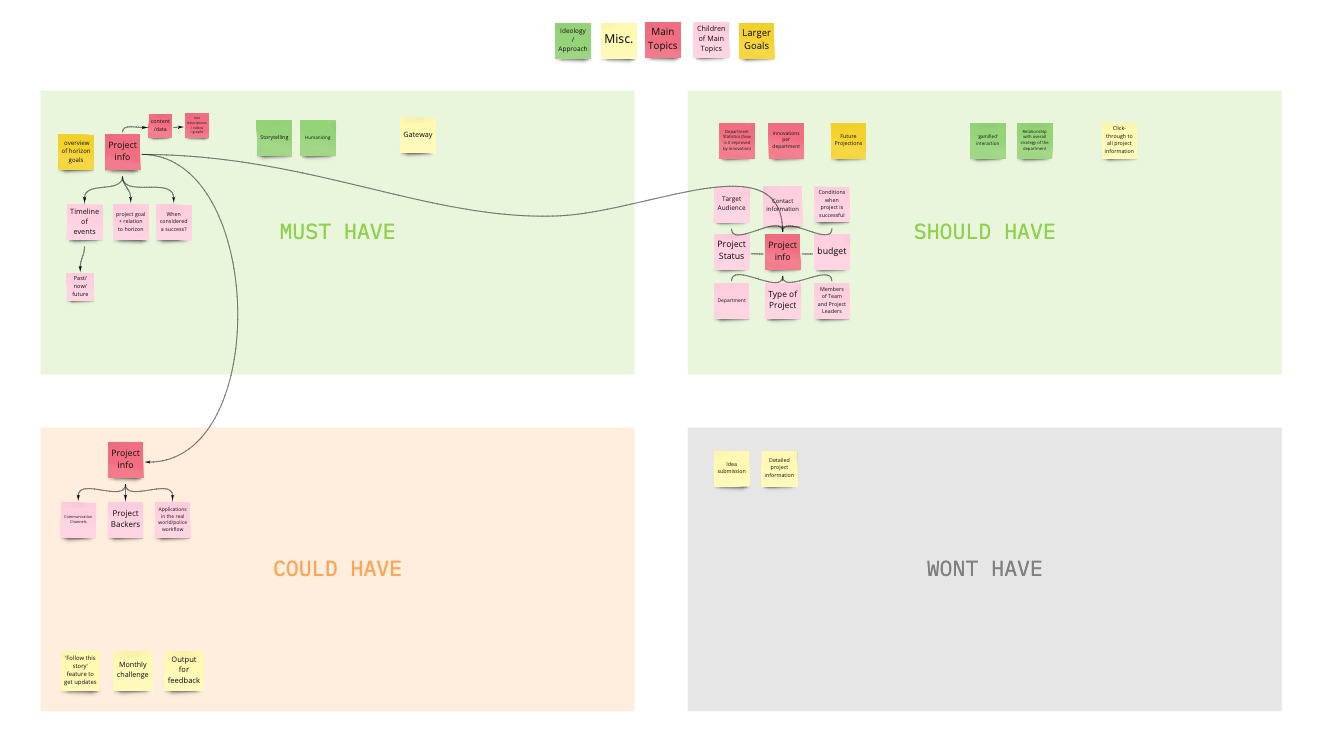
The outcome of the exploration phase was a conceptual platform designed to make innovation projects visible, comparable and easier to navigate. Rather than delivering a fully realised product, the concept focused on providing structure, overview and a shared reference point for teams working on innovation initiatives.
The platform served as a tool for sense-making, enabling stakeholders to understand where projects stood, how they related to one another and what was needed to progress.

A lo-fi prototype helped us to identify the needs of the stakeholders. Management, and therefore our people of contact, had to desire to have a budget-focussed approach. However, we found out that at least 80% of the organisation doesn't value the budget-focused approach, and it doesn't solve the identified problem of the bad name of innovation within the Police. Therefore, we let them interact with a timeline view as well, as scientific research taught us that this is an effective way of storytelling. This interaction was much more appreciated. We took notes of the test and continued in this direction.

The result is an interactive platform that makes the status of innovation tangible with the help of storytelling and visualising the progress of innovation and its effects over time.
Themes are the overall goals of the innovation team. These themes overarch the projects and have their strategic goals and budget. Projects are what people are working on to meet the goals of its theme. This includes the outcomes of a project and the progress with GO/NO GO moments.
Projects that contribute to a theme reveal an overview and the team that is working on the project and their progress. This expanded progress information let managers and staff get a better understanding of innovation.

To solve the problem of employees feeling that innovation doesn't help them in their job, we highly investigated in a dedicated filter.

For the officers on the street, a mobile version of the platform is convenient.

We ran a user test with our final prototype and concluded that we should make the visual relationship between themes and projects more straightforward. Additionally, we find it essential for the innovation team to interpret the success of their efforts effectively. Therefore, we would like to formulate a way to measure results so the Politie can make future decisions based on past work successes.

In our mid-fidelity design, we made a progress bar and floating text. However, it didn't work once I tested the design on the colour blindness condition Protanopia. The red line and golden tect made it difficult to read the words and understand the progress bar. Therefore, we redesigned this element.

This project reinforced the importance of design in early-stage, ambiguous contexts. By focusing on structure and facilitation rather than delivery, I learned how design can support alignment and decision-making long before solutions are defined. It also strengthened my ability to translate abstract challenges into tangible artefacts that teams can discuss, critique and build upon.
This project was carried out within an interdisciplinary team, working closely with stakeholders across the police organisation. My role focused on structuring the exploration process, facilitating workshops and translating abstract insights into tangible concepts. The emphasis of my contribution was direction-setting rather than delivering a final product.
Streamlining the workflow for the Dutch investment bank for developing countries

Unifying planning, visits and performance for sales teams worldwide

A new mobile experience for handymen and decorators in the Netherlands and Belgium.